 Eleutherian College
Eleutherian College
Eleutherian College
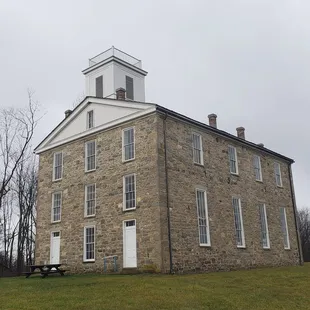
Eleutherian College in Lancaster, Indiana
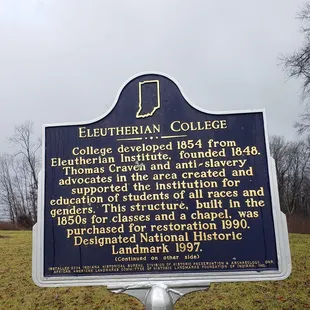
A historic marker was placed in 2004.
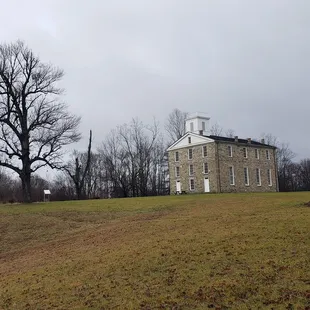
Distant shot of Eleutherian.

Richard P.
Jan 15, 2024
For Martin Luther King Jr. Day, I thought I'd pull up a review for a piece of Black history in Indiana. To my surprise, Eleutherian College is unreviewed. Sometimes, you just stumble into the coolest places. Eleutherian College, founded as Eleutherian Institute, was founded by local anti-slavery Baptists in Lancaster, Indiana (about 10 miles north of Madison). The school began instruction as a secondary school on Nov. 27, 1848 and was known for admitting students without regard to ethnicity or gender - this included freed and fugitive slaves. In 1854, it was renamed Eleutherian College because it began offering college-level coursework. It closed in 1874 and the main building became a private school and then a public high school. It is now operated by a non-profit organization. Eleutherian was the second college in the U.S. west of the Allegheny Mountains and the first in Indiana to provide education to students of different races. The three-story stone chapel and classroom building was built between 1853-1856 and currently serves as a museum for local history. In 1993, it was listed on the National Register of Historic Places and became a National Historic Landmark in 1997. In the decade before the Civil War, African-American students comprised 1/4 to 1/3 of total enrollment. At one point, enrollment reached 150 students. Interestingly, no Black students were enrolled past 1861. During the Civil War, the grounds were used for military training. The main building was used for meetings/concerts. You can actually tour inside and work continues in terms of renovation. The Lancaster area during this time was known for its anti-slavery sentiment. While I know Eleutherian has had some renovation done, my undNoteworthy graduates include Moses Broyles, who became pastor of the Second Baptist Church in Indianapolis and an organizer of the Indiana Association of Black Baptists Churches in 1858. Broyles was a slave from Kentucky who purchased his freedom as an adult.Notable female students included Sarah B. Hoyt, who also studied at Oberlin College. She became a teacher and later served as a high school principal at Newport, Kentucky. Also, Rebecca J. Thompson, who completed studies at the Young Ladies Institute, which later became Shepardson College in Granville, Ohio, was chair of the mathematics department at Franklin College (Indiana) for thirty-eight years. She retired from Franklin College in 1910.It's worth noting that as a historic building accessibility is limited. It's likely possible to get to the first floor (some assistance may be needed). For the exterior, the main building was constructed in the Greek Revival style. The three-story building has a rectangular plan that includes a square bell tower (belfry) centered above a gable-fronted main entrance. The gable roof includes a triangular-shaped wood pediment above the third-floor windows. The building's windowsills, lintels, and corner quoins are finished limestone, which contrasts to the rough-hewn stone walls. The north (front) facade of the building has three bays wide with two wooden doors flanking a single, ground-floor window. East and west facades are identical, with four double-height windows below four more on the third level. The south (rear) facade has two windows at the third-floor level.In terms of interior, the main building has a small entryway leading to a two-story chapel that runs the length of the building. The chapel includes double-height windows and a balcony, which crosses the north side of the room. The chapel ceiling is covered in wood panels. Stairs at each end of the entry hall lead to the upper floors. The second story includes two classrooms above the entryway and five additional rooms on the third floor. Stairs in one of the third-floor rooms leads to an unfinished attic. A ladder in the attic leads to the belfry tower. The cast bell was manufactured by J.A. Kelley of Franklin Brass Bell Factory, Madison, Indiana.This is a pretty significant part of Black history in Southern Indiana leading up to the Civil War. All of Madison is worth a day trip and that day trip should include a stop at Eleutherian. Contact Historic Eleutherian College, Inc. for more information!
Read More